

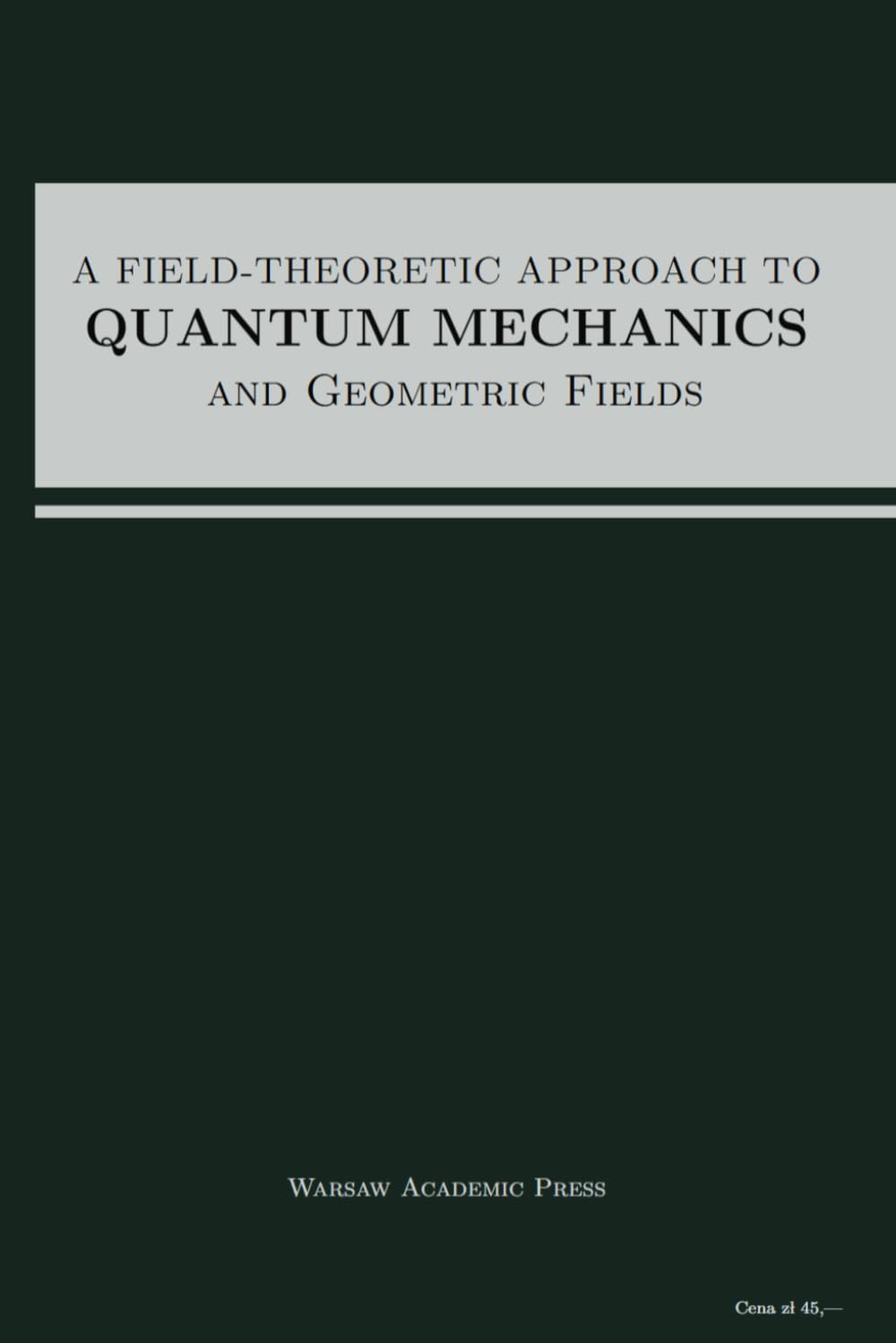
The Substrate Theory of Everything - A Comprehensive Textbook
Product details
| Management number | 233381533 | Release Date | 2026/06/27 | List Price | US$13.95 | Model Number | 233381533 | ||
|---|---|---|---|---|---|---|---|---|---|
| Category | |||||||||
This textbook presents the substrate theory of everything — a candidate unified framework for fundamental physics — at a level appropriate for senior undergraduates. The text is self-contained: all mathematical tools, derivations, and physical reasoning are explained from first principles. A student with a solid grounding in classical mechanics, electromagnetism, undergraduate quantum mechanics, and basic special relativity should be able to follow the entire development.The substrate theory rests on eight foundational postulates. From these, the theory derives — rather than postulates — Newton's laws, the equivalence principle, special and general relativity, the Born rule of quantum mechanics, the Standard Model gauge structure, particle masses, dark matter and dark energy, the matter-antimatter asymmetry, and inflation. The framework offers a single coherent picture of physics from the Planck scale (10⁻³⁵ m) to the cosmological horizon (10²⁶ m) — a range of 60 orders of magnitude.Writing a textbook on a candidate theory is unusual. Most textbooks present established physics. Here we present a framework still under empirical evaluation. Several specific predictions have been validated against observation (inflation observables, the MOND scale, the matter-antimatter asymmetry, the equivalence principle, dark energy density to within an order of magnitude); others will be tested by experiments scheduled for the period 2025–2045. The reader should view this textbook as a comprehensive introduction to a serious theoretical proposal — one that may turn out to be correct in detail, correct in spirit but requiring revision, or incorrect — but which is in any case a model for how to do unified theoretical physics.We have made the following pedagogical choices throughout. First, derivations are complete: every equation that appears either is derived in the text or is referenced to a clearly-marked appendix derivation. Second, numerical computations are explicit: where simulations or numerical methods are used, we show both the results (with charts) and the underlying Python code (in Appendix A). Third, physical interpretation is consistently emphasized: each mathematical result is connected to physical meaning. Fourth, comparisons with established theories are provided throughout: where substrate theory makes predictions that differ from standard physics, we explicitly identify the difference and the experimental discriminator.The textbook is organized in eight parts. Part I sets up the framework: the unsolved problems of modern physics, the mathematical tools we will use, the eight postulates, and the framework Lagrangian. Parts II–IV derive classical mechanics, relativity, and quantum mechanics from the framework. Parts V–VI extend to quantum gravity and grand unification. Part VII addresses cosmology — including the dark sector and the cosmological constant problem. Part VIII presents predictions, observational tests, and comparison with other theoretical frameworks.We close the preface with a note about the level. This is a senior undergraduate textbook, not a popular exposition. The mathematics is real: tensor calculus, Lie algebras, functional integrals, renormalization group flow, group cohomology where needed. We do, however, take care to explain mathematical structures as they arise, and we provide complete worked derivations rather than asserting results. A motivated and patient student should be able to follow every step. Sections marked with an asterisk (*) are advanced and may be skipped on a first reading. Read more
| ASIN | B0H2WQB3G5 |
|---|---|
| ISBN13 | 979-8198310933 |
| Language | English |
| Publisher | Independently published |
| Dimensions | 8.49 x 1.25 x 11.24 inches |
| Item Weight | 2.84 pounds |
| Print length | 469 pages |
| Publication date | May 23, 2026 |
Bestseller ranking
Crib Mattresses




Customers who viewed this product also viewed
Gravity



Correction of product information
If you notice any omissions or errors in the product information on this page, please use the correction request form below.
Correction Request Form